
By That Green Union Guy - IWW Environmental Union Caucus, August 11, 2022
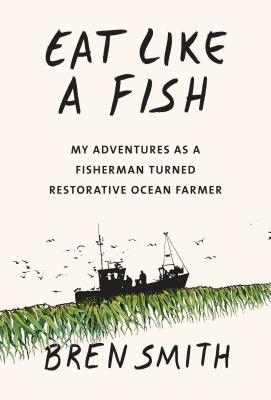 Eat Like a Fish: My Adventures as a Fisherman Turned Restorative Ocean Farmer (2019: Knopf Publishing), is a personal, autobiographical account by Bren Smith, a one time, working class fisherman and native of Newfoundland turned pioneer of regenerative ocean agriculture.
In his early adult and working life, Smith experienced all the horrors of capitalist fishing industry, including its deeply detrimental effects on workers, the environment, and consumers. After much trial and error, mostly error, and after many wrong turns in life, he learned methods of regenerative ocean farming.
Regenerative ocean farming involves growing seaweed & kelp in poly cultures vertically in small cubic volumes of water. It also can include shellfish and other aquatic species which clean toxins out of the ocean, diversify and increase biomass, and restore once dead zones. If done on a massive scale, they can be a major (if overlooked) solution to climate change which produces food, creates livelihoods, and restores the ocean environment.
This is neither a technocratic solution dreamed up by well endowed universities or Big Green NGOs, nor is it a greenwashing false solution proposed by green capitalists; it’s a solution based on empirical study and proof of concept. Though, to be certain, green capitalists have tried to monetize and commodify it, but Smith and his coworkers have resisted that process and have instead structured their organization, Green Waves (as much as possible) to resist that process and instead encourage a cooperative model.
Such a model, if taken to its ultimate potential, could be part of a worker controlled, green syndicalist/eco socialist program (though, thus far it’s being presented as part of a potential “Blue New Deal” in combination with the much more widely discussed GND). Indeed, Smith has since joined Labor Network for Sustainability, which share shis green unionist vision.
Smith's very accessible account meanders, but never rambles, which is a strength, as it is an authentic life story. Every so often, Smith pauses to include quick “how to” guides. The book is not in any way overly technical nor wonky, and it never talks down to the reader. There’s even a small collection of recipes after its conclusion. It’s a welcome contribution to potential green unionist led just transition solutions, something that’s both highly recommended and very much needed.
More than anything else, the book will leave the reader hopeful, in the proactive sense. It's yet another account that shows that workers directly working in any industry can find solutions to overcome its destructiveness and oppressiveness by eliminating the influence of capitalism.