
By Tom Scribbner - IWW, 1966
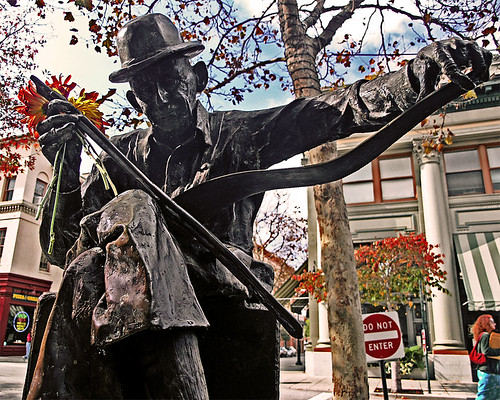 Image (right): statue of Tom Scribbner with his musical saw, located in downtown Santa Cruz, California.
ecology.iww.org Web Editor's Introduction: this book is included primarily for historical accounts as well as entertainment.
Tom Scribner was a timber industry worker and a union organizer his entire life. He joined the IWW in 1914 and was a part of the LWIU's fight for the eight-hour day. He participated in the formation of the once radical International Woodworkers of America (IWA) of the CIO (now merged with the International Association of Machinists (IAM) in the AFL-CIO). He was an unabashed member of the American Communist Party during its heyday in he 1930s. He founded two newspapers, Lumberjack News and Redwood Ripsaw. He was a radical all his life, and wrote a great deal. Much of his best work, he self-published in Lumberjack.
This website includes a complete, unabridged copy of Tom Scribner's self-published book, Lumberjack, originally published in 1966. Between 1990-94, the members of Santa Cruz General Membership Branch of the IWW reproduced several hundred copies of Lumberjack, however they made a conscious decision not to make any alterations to Scribner's original work. This meant that no corrections were made to spelling, grammatical, or punctuation errors. Furthermore, it meant that they made no annotations or clarifications where Scribner's politics differed from their own, even though the work was circulated and sold as unofficial IWW literature. As a result, there are several potential problems that we found it necessary to address.
It is most appropriate to leave unaltered numerous grammatical errors made by Scribner, as he was a timber worker his entire life and not a scholar. Scribner himself apologizes in his own introduction for "bloopers on the Kings English". Members of the Santa Cruz IWW believed, as do we, that to change these would be to ruin the character of the writing and the tenor of the work. however, where we part company with our Fellow Workers' concerns spelling and punctuation errors. We have cleaned these up, as we found it necessary to do so, because retention of spelling errors could cause unsuspecting visitors to this website to regard us as dolts and radicals on the left are always subject to much greater criticism then just about anybody else. Furthermore, corrections of such errors make the writing easier to understand. We feel nothing has been lost in the translation and transcription.
We have also made some additions, notably the assignment of "chapter numbers" to allow for easy reference (even though Scribner didn't even include a table of contents). Furthermore, we have made an occasional annotation (in the form of footnotes) to clarify points that might be obscure to most readers. A few footnotes note, admittedly ideological difference that we have with Scribner. Most of these concern his position on Communism. Scribner was an unapologetic pro-Soviet Communist, i.e. he believed that the Soviet Union represented a step forward for the Working Class (it is not clear whether or not Scribner was a Stalinist. He has nothing to say about Mao or Trotsky in any of the writings featured here, nor does he offer any criticism of Stalin for that matter). History has, in our opinion, proven Scribner quite wrong. Furthermore, the IWW Constitution and the theories that most Wobblies have about industrial unionism differ very sharply from Scribner's concept of Proletarian Revolution.
The IWW believes that the only way that we can achieve true, maximum individual freedom for everyone as well as a world in which we can all live sustainably, is through industrial organization. Direct action at the point of production, and organization in the workplace (or at the community level). Political parties (not to be confused with political action which is any action that involves political issues, be they labor, environmental, or social justice) and seizure of state power are a tactical and strategic cul-de-sac that will only result in the continued oppression of he working class. Scribner did not hold the same views and because of this, he quit the IWW after the organization suffered a damaging split in 1924.
Why include his writings then, if he was no longer a complete believer in the industrial unionism of the IWW? The answer is simple. He was a member of the IWW (at least for ten years) and a timber worker all of his life. Despite his ideological disagreements with the IWW, he rightfully points out that the IWW did more for timber workers in North America than any other organization. Furthermore, he describes aspects of the timber industry that can be found nowhere else. Finally, he was a union organizer, whatever his politics, and the IWW believes that organizing the unorganized is essential to abolishing wage slavery.
Furthermore, one may well ask, why include (almost*) ALL of Lumberjack? Not all of the articles he wrote concerned the timber industry. Some are merely political, such as "Jungle Warfare", "The Clean Bomb", or "Economic Determinism." Others are allegorical, such as "Council Meeting in Barbaria" or satirical, such as "The American Standard of Living". A few are even problematic, including especially the most lengthy chapter concerning the "Communist Era", as it could give the unsuspecting reader the wrong impression about the IWW (thus this is the most annotated chapter). We retain all of these chapters, because they say something about the man who was, despite his lack of formal education, a very streetwise individual, self educated in the ways of socialism and labor organizing, and certainly human. Essentially, were we to disregard any of Scribner's, work we would be burying part of our history.
Finally, it need be pointed out that not all of the work is Scribner's. Two short chapters are reprints of pieces by Socialist Eugene Debs, one other chapter represents brief quotes from The Lumber Industry and its Workers (included elsewhere on this website), and one poem is the work of a contributor to Redwood Ripsaw (H. I. Phillips). There are also various poems by IWW members. These are included exactly as they were transcribed in Lumberjack. Whatever the source, Scribner had a colorful way of expressing himself and a keen sense of humor. Each of these chapters are entertaining (certainly not dry and boring as you might expect from an academic leftist) and engaging. We're sure most of you will enjoy.
Footnote:
* The original document at our disposal lacks the appendix on the musical saw. Efforts to track down a copy of this index have, thus far, proven unsuccessful. If that changes, we will append it to this archive.