
Introduction by Clarence Darrow, Charles Kerr Press, June 6, 1925
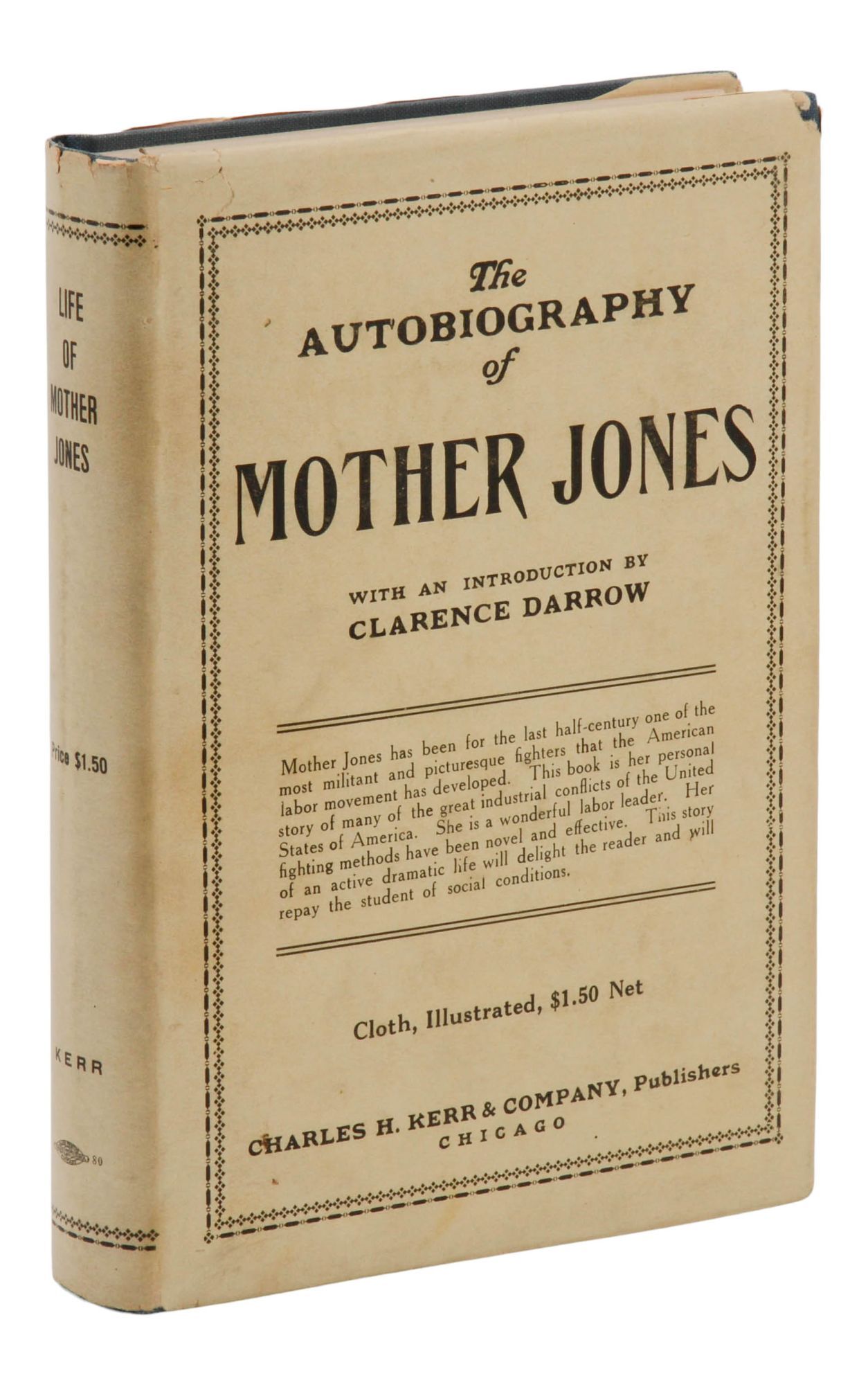 Mother Jones is one of the most forceful and picturesque figures of the American labor movement. She is a born crusader. In an earlier period of the world she would have joined with Peter the Hermit in leading the crusaders against the Saracens. At a later period, she would have joined John Brown in his mad, heroic effort to liberate the slaves. Like Brown, she has a singleness of purpose, a personal fearlessness, and a contempt for established wrongs. Like him, the purpose was the moving force, and the means of accomplishing the end did not matter.
In her early life, she found in the labor movement an outlet for her inherent sympathy and love and daring. She never had the time or the education to study the philosophy of the various movements that from time to time have inspired the devoted idealist to lead what seemed to be a forlorn hope to change the institutions of men.
Mother Jones is essentially an individualist. Her own emotions and ideas are so strong that she is sometimes in conflict with others, fighting for the same cause. This too is an old story; the real leaders of any cause are necessarily individualists and are often impatient of others who likewise must go in their own way. All movements attract men and women of various minds. The early abolitionists could not agree as to methods. In their crusade were found the men who believed in constitutional methods, such as Giddings and Lincoln; the men who believed in force, of which John Brown was the chief; the non-resistant, like William Lloyd Garrison; the lone individualist who hit wherever he found a head to hit, like Wendell Phillips. Mother Jones is the Wendell Phillips of the labor movement. Without his education and scholarship, she has the power of moving masses of men by her strong, living speech and action. She has likewise his disregard for personal safety. After the capture of John Brown at Harper's Ferry, many real abolitionists were paralyzed with fear and fled from the field, but Wendell Phillips hurled his phillipics from the housetops and defied his enemies to do their worst.
In all her career, Mother Jones never quailed or ran away. Her deep convictions and fearless soul always drew her to seek the spot where the fight was hottest and the danger greatest.
I never personally knew anything of her misunderstandings with John Mitchell, but it seems only fair for me to say that I was associated with him for many months in the arbitration growing out of the coal strike. We were friends for many years and he always had my full respect and trust. I cannot help feeling that both were true and that the disagreements were only such as inevitably grow out of close association of different types of mind in a great conflict.
Mother Jones was always doubtful of the good of organized institutions. These require compromises and she could not compromise. To her there was but one side. Right and wrong were forever distinct. The type is common to all great movements. It is essentially the difference between the man of action and the philosopher. Both are useful. No one can decide the relative merits of the two.
This little book is a story of a woman of action fired by a fine zeal. She defied calumny. She was not awed by guns or jails. She kept on her way regardless of friends and foes. She had but one love to which she was always true and that was her cause. People of this type are bound to have conflicts within and without the ranks.
Mother Jones was especially devoted to the miners. The mountainous country, the deep mines, the black pit, the cheap homes, the danger, the everlasting conflict for wages and for life, appealed to her imagination and chivalry. Much of the cause of trades unionism in England and America has been associated with the mines. The stories of the work of women and children in the mines of Great Britain are well known to all trades unionists. The progress of trades unionism in England was largely the progress of the miners' cause. The fight in America has been almost a replica of the contest in Great Britain. Through suffering, danger and loyalty the condition of the miners has gradually improved. Some of the fiercest combats in America have been fought by the miners. These fights brought thousands of men and their families close to starvation. They brought contests with police, militia, courts and soldiers. They involved prison sentences, massacres and hardships without end. Wherever the fight was the fiercest and danger the greatest, Mother Jones was present to aid and cheer. In both the day and the night, in the poor villages and at the lonely cabin on the mountain side, Mother Jones always appeared in time of need. She had a strong sense of drama. She staged every detail of a contest. Her actors were real men and women and children, and she often reached the hearts of employers where all others failed. She was never awed by jails. Over and over she was sentenced by courts; she never ran away. She stayed in prison until her enemies opened the doors. Her personal non-resistance was far more powerful than any appeal to force.
This little book gives her own story of an active, dramatic life. It is a part of the history of the labor movement of the United States.