
By That Green Union Guy - IWW Environmental Union Caucus, May 11, 2023
 As the climate crises continues to deepen and as climate justice movements continue to rise to meet it, the concept of a just transition and/or a just transformation continues to be an ever present topic of discussion. However, most of these discussions remain in the abstract "what if?" realm, rather than the specific. Further, many workers and unions, even more revolutionary workers and unions, express skepticism due to lack of concrete examples of a just transition in practice.
The burning question is, do examples of worker crafted, specific concrete transformative plans exist and what do they look like?
Indeed, they do, and one of the best known examples is the Lucas Plan.
(From Wikipedia) The Lucas Plan was a January 1976 document produced by the workers of Lucas Aerospace Corporation. The shop stewards at Lucas Aerospace published an Alternative Plan for the future of their company. The plan was in response to the company’s announcement that thousands of jobs were to be cut to enable industrial restructuring in the face of technological change and international competition. Instead of being made redundant the workforce argued for their right to develop socially useful products.
In the most basic sense, the Lucas Plan was an example of green syndicalism in practice.
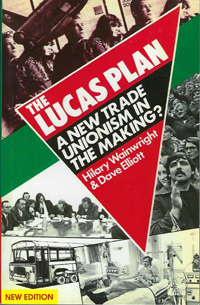
What's even better, is that it's actually a well documented example, and The Lucas Plan: A New Trade Unionism In The Making? (Second Edition, Spokesman: 2018), by Hilary Wainwright and Dave Elliot, covers it all in rich, thorough detail. The book documents how the Lucas Aerospace, Shop Stewards Combine Committee, devised the plan, formed workplace committees, and devised a strategy to achieve it.
The workers possessed the necessary skills and determination to realize the plan, and they overcame many challenges, including craft divisions within the various unions that represented the Lucas Aerospace workers, as well as different left political tendencies among the rank and file workers and their shopfloor leadership. What these workers were unable to overcome were the inevitable refusal of the capitalists to agree to their demands, made all the more immobile by opposition from the workers' unions' officialdom, lack of support or interest from the various organized left parties and movements and obstruction from both of England's major political parties (Labour and Conservative).
The authors rely heavily on interviews and testimony from many of the workers who participated in the struggle, and as a result the account offers a variety of perspectives and honest self-criticism. The authors and the workers interviewed offer much advice on how to avoid the mistakes of the past.
The best aspect of this book, is that it covers all of this in very complete and fine detail. It's worst aspect, unfortunately, is that to does so in very dry prose, and to make matters worse, the publishers elected to limit expenses by using very small and dense typeface. This makes the book rather challenging to read.
Another limitation is that not nearly enough attention is given to how the obstacles that prevented the plan from becoming reality could be overcome, especially given the fact that objective conditions are substantially different now, than they were in 1976. For example, climate change was then a distant possibility most people didn't even know about much less think about. Further, the Lucas Plan was conceived in the beginning of neoliberal capitalism's ascendancy, and ran counter to the latter's laizzes-faire dogma. To make matters worse, most left movements as well as the union movement were in decline (for a variety of reasons, including external repression and internal contradiction and dysfunction). All of these factors meant that the Combine Committee was swimming against a very forceful stream.
Things are quite different in 2023. Climate Change is an increasingly stark reality, left movements are growing in size and number, and union organizing is accelerating (though not necessarily without some setbacks or wrong turns). Capitalism is becoming increasingly unpopular and neoliberalism as an ideology is in free-fall decline. In other words, conditions are much more favorable to something like the Lucas Plan, and, if the advice offered by the book is followed--challenging though it may be to digest--it would have a much better chance of success. Because of these things, this book is an essential read.