
Claim: The Protests just funnel demonstrators back into electoralism; Protests aren’t enough; more organized, militant action is needed; and the protests are a start, but they’ll amount to nothing without real organizing.
These and many other similar claims made about mass mobilizations and protests such as “No Kings” are frequently made, and widely shared and believed among many sectarian left critics, but they’re based on at least three misconceptions:
- The protests are meant to be the be-all-and-end-all;
- The organizers of the protests don’t have and don’t advocate steps beyond them; and
- Revolutions are won in single strokes, rather than ongoing sustained struggles.
None of these are true, just as none of the claims made about what the protests do or are intended to do are entirely (or even partially, in some cases) true.
Mass demonstrations have a fairly well researched history, and a good summary of them in the US can be found in the book, How to Read a Protest, by L. A. Kauffman. The book begins with a concise, yet thorough, account of the March on Washington, organized in 1963, followed by shorter comparative accounts of the mass marches of similar size that followed up to and including the Women’s Marches that activists pulled together at the start of the first Trump presidency in early 2017.
While many of the boilerplate criticisms made of contemporary mass demonstrations (such as “No Kings”) don’t actually apply, they do much more closely apply to the March on Washington, but even then, only to a partial extent. That particular match was tightly controlled by its organizers. All of the signs were mass produced, all of the slogans displayed by marchers had to be preapproved, and the speeches delivered by the speakers toned down (which is ironic, given the historical fact that this is when and where Martin Luther King Jr. gave his famous “I Have a Dream” speech). While the purpose of the march wasn’t to funnel its participants into electoralism, it most certainly was “an appeal to authority” (in this particular case, the John F Kennedy Jr Administration and the then Congress) to pass civil rights legislation. However, lest one think the march constituted “sheepdogging” its participants into the Democratic Party, its organizers consisted chiefly of black civil rights organizations (running the gamut from black churches to Marxist in their orientation), and white leftists, particularly many with Marxist-Leninist tendencies.[1]
Most of the mass demonstrations that have followed the March on Washington have not been so timid or tightly controlled. Messages are usually up to the participants, speeches are often less controlled or timid, and the goals have been far more varied. Nevertheless, it should be noted that, none of these mass demonstrations, including the March on Washington, were ever intended as an end in themselves. The notion that the organizers of such events harbor the fantasy that their plan is to turn out 100,000s or 1,000,000s which will then induce the powers that be to “see the light” is romantic myth, often encouraged by the popular entertainment industry (which is notoriously adept at watering down history).
The purpose of mass demonstrations are multifaceted, and they include the any or all of the following purposes (among others), in no particular order:
- They allow people to actively protest unpopular policies, actions, decisions, or regimes publicly and visibly;
- They let those attending see (often quite dramatically) that they are not alone, and that their views are shared, quite even possibly by a popular majority;
- They provide people a chance to overcome their fears and hesitations, discover their collective strength and power, and take proactive steps instead of just passive acceptance;
- They create potential spaces for networking, building connections, joining existing groups and movements, and taking steps towards more active, or even more militant, tactics and organizing;
- They potentially reveal to others, particularly those not yet ready to attend such demonstrations that they can overcome their fears and hesitations;
- They undermine the illusion of popular support or political mandates for the regime being protested, thus making it easier to remove the latter’s “pillars of support”.
Having attended many of the “No Kings” organizing meetings (which are accessible to anyone wishing to attend them if they have internet access), I can attest to the fact that the organizers are quite cognizant of the fact that such demonstrations aren’t ends in themselves. The organizers are keenly aware that they’re not, by themselves, sufficient to remove Trump from power, that more militant (albeit nonviolent) tactics will be necessary, that electoral solutions aren’t enough, that the struggle will require sustained effort, and that all of the above requires diligent, methodical organizing.
Having closely followed the organizing efforts behind “Hands Off” and “No Kings”, in my experience the organizers have never discouraged participation in more militant organizing. They’ve routinely supported the community defense and direct actions against ICE and Trump’s attempts to militarize predominantly black and brown urban centers. They’ve held webinars on building mutual aid networks. They’ve encouraged people to help build the organization necessary to support a general strike (including the January 23, 2026 strike in Minneapolis). They’re not hesitant about supporting organized labor, climate action, or antiwar protests either (in spite of inane, sectarian memes asking why “No Kings” doesn’t support such things, which also answer in a sneering and snarkily dismissive—not to mention utterly inaccurate—tone, “because Democrats support none of these things”).
The sectarian left critics are either ignorant or deliberately arguing in bad faith, however. Here are some examples that prove this is so.
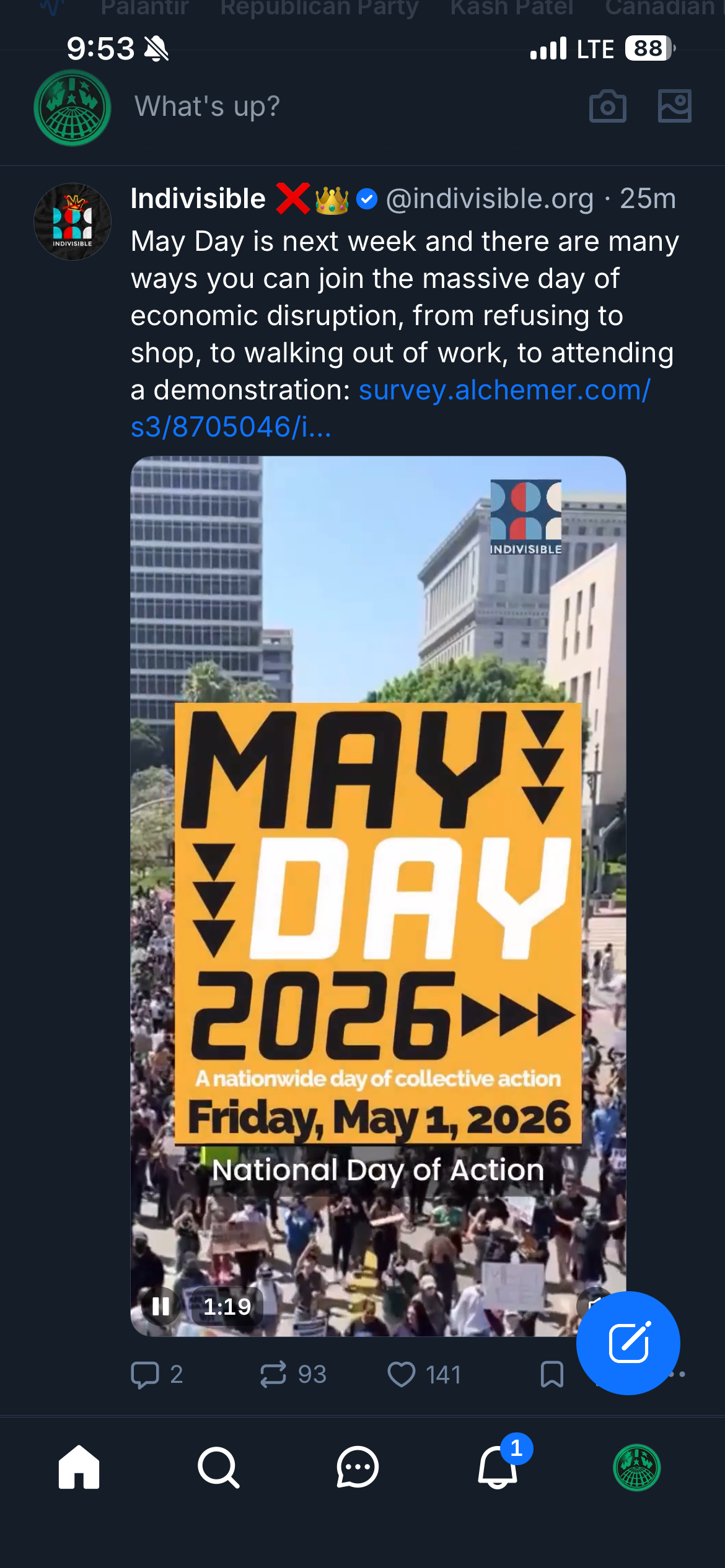
Here is a screenshot of Indivisible urging people to join in the 2026 May Day actions:
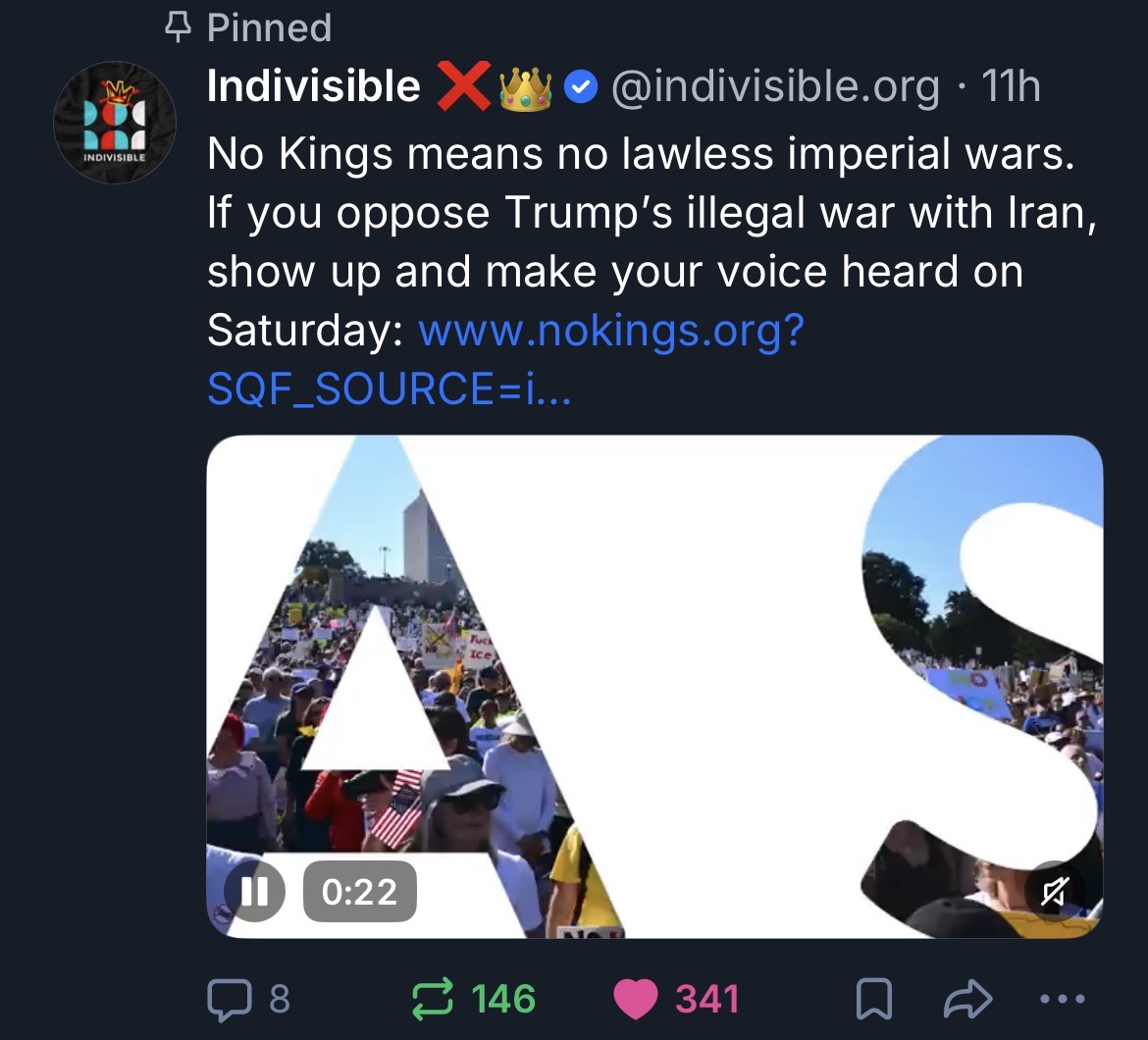
Here is a screenshot of Indivisible stating, quite unequivocally, their opposition to Trump’s war of choice in Iran, and why “No Kings” implicitly includes opposition to such things:
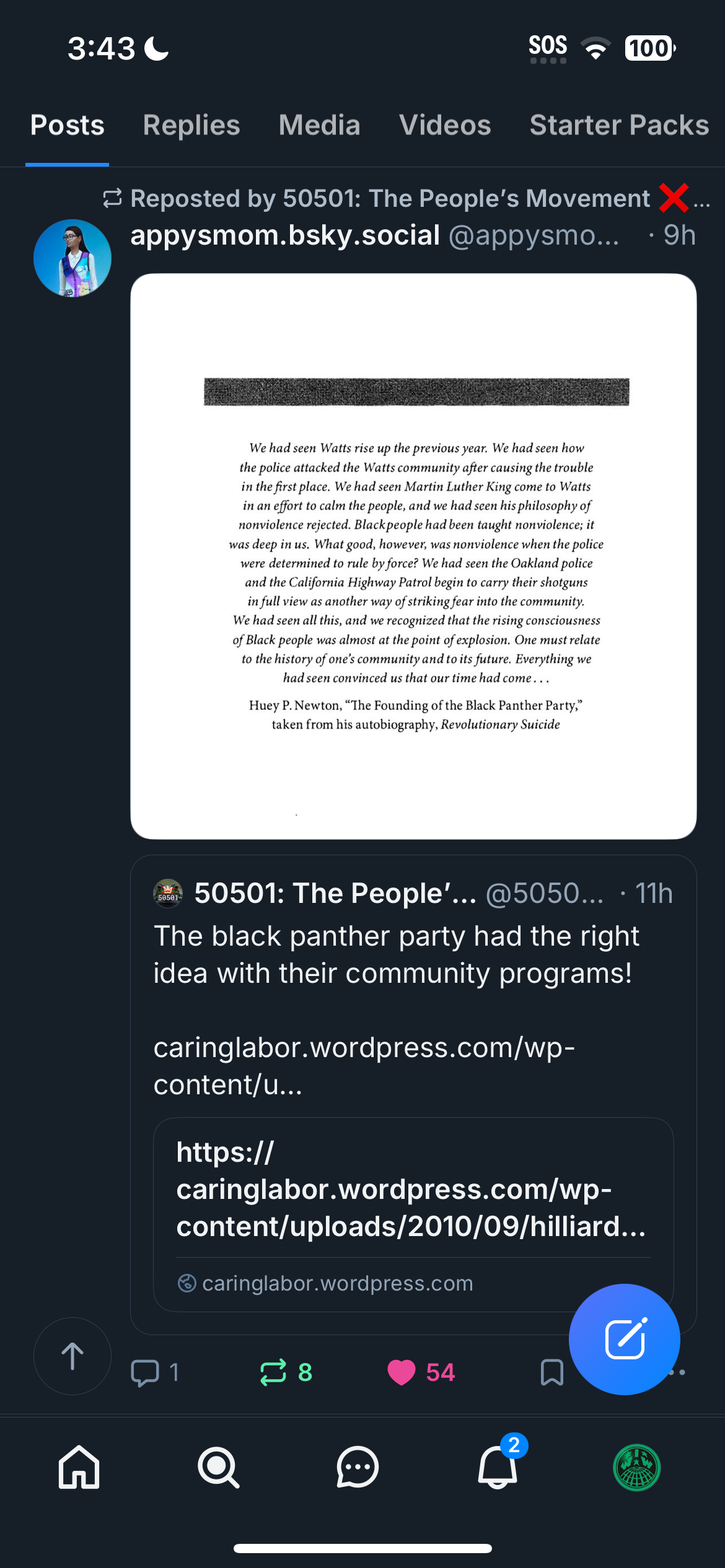
Here is a screenshot of 50501’s Bluesky page speaking favorably of the (Marxist-Leninist) Black Panther Party’s breakfast program (an example of mutual aid in practice):
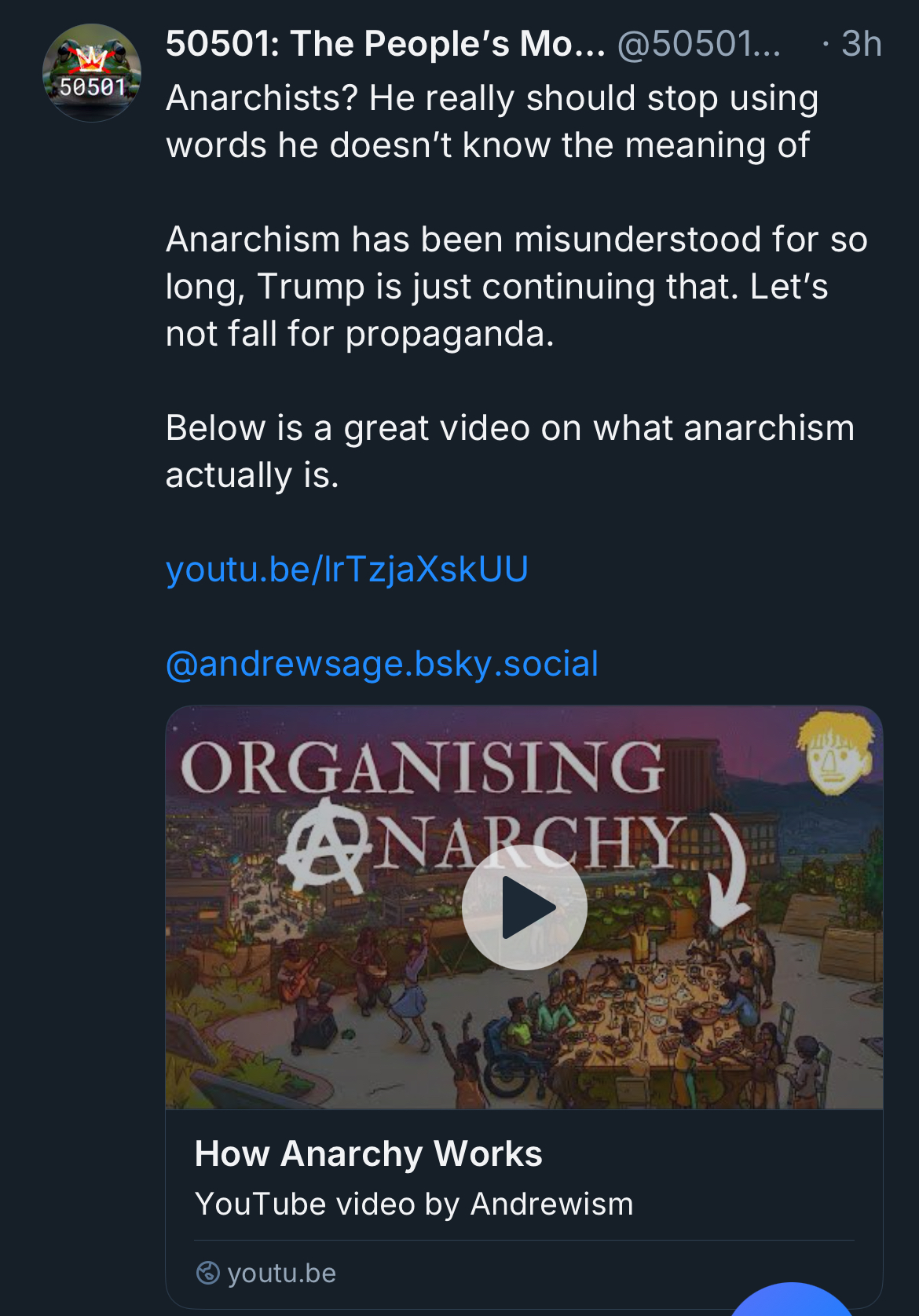
Here is another 50501 Bluesky screenshot of a post with a link to a favorable video on anarchism that explains what it is and what it isn’t (in response to Trump trying to stoke fears about it):
Here is yet another 50501 Bluesky screenshot encouraging people to form local organizations and mutual aid networks:
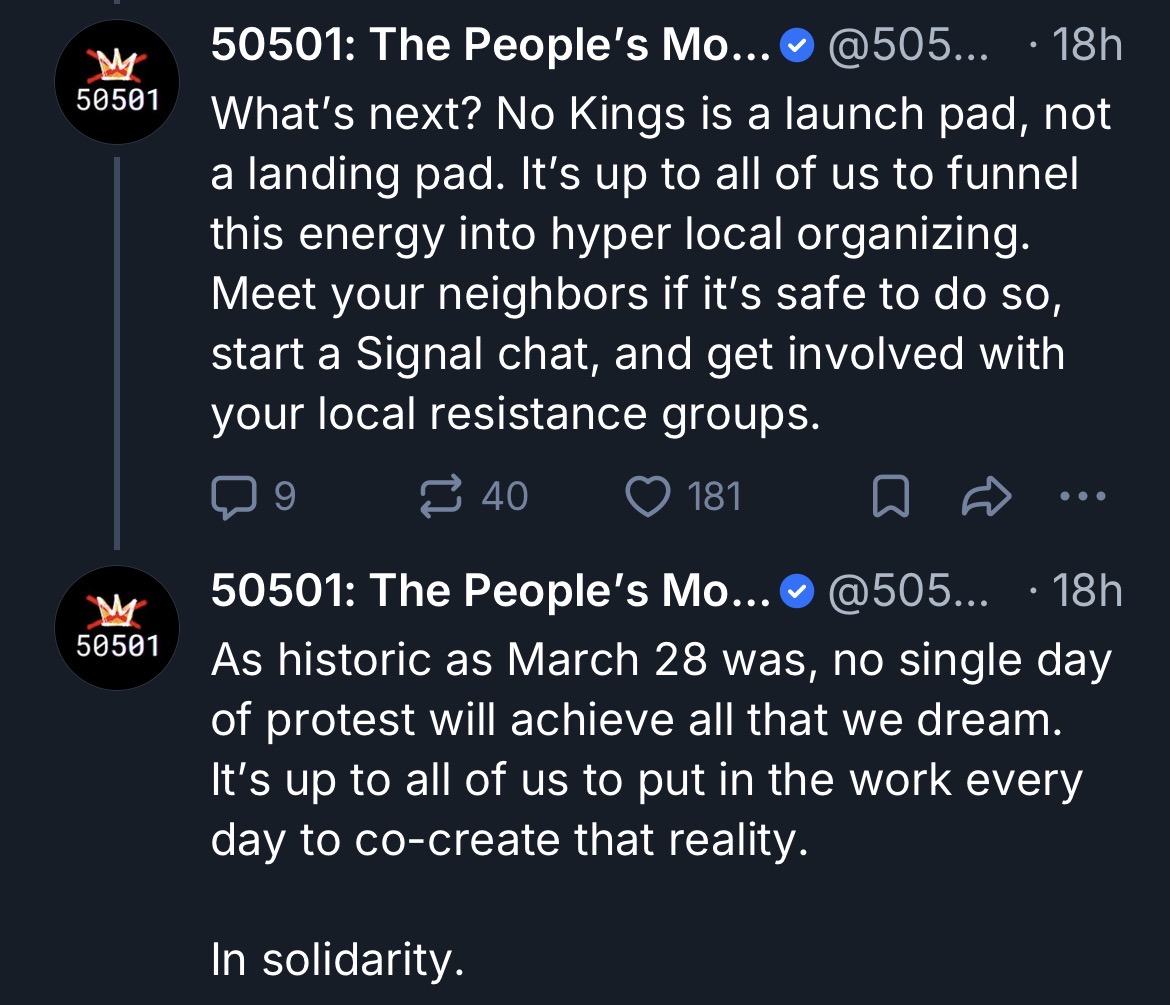
Do these examples suggest that either 50501 or Indivisible have fully embraced Marxist-Leninism or libertarian communism? Hardly. Yet, it does indicate that they’re at least open to elements of them, and furthermore, even if they’ve not fully embraced either revolutionary theory doesn’t automatically make either 50501 or Indivisible strictly “reformist” either. What it also indicates, is that the aforementioned organizations aren’t convinced that either Marxist-Leninists or anarchists have all of the answers to the questions we face, even if they might have some of them.
“But, but, but, the organizers behind ‘No Kings’ still encourage the participants to vote for the Democrats!” many of the critics say, thus lending credence to the claim that such demonstrations ultimately funnel people back into electoralism, particularly favoring the Democratic Party. Strictly and technically speaking, that’s true, but it’s not as sinister as the critics make this sound, for the following reasons:
- The overwhelming majority of protesters are likely to favor the Democrats anyway, and the only question for them, relevant to that context anyway, is whether to vote or not;
- There’s no law of nature that says that if someone chooses to vote in an election (including voting for Democratic Party candidates) this somehow abrogates or precludes them from also engaging in more militant actions (including mutual aid, strikes, or other forms of direct action);
- There’s no evidence that anyone advocating third parties, including registering marches participants to vote for those parties, have been excluded;
- While it might seem tempting to argue that massive demonstrations that can mobilize as many as eight million demonstrators could simply move on to the seemingly logical step of breaking from the Democratic Party and forming a new, left / workers’ party (or joining an existing third party en masse) that’s a lot more easily said than done, and eight million is far short of the minimum size of the political machine necessary to make such a party viable.[2]
Given the above, the main reason why the organizers of mass demonstrations encourage—well, to be more accurate, they don’t discourage—electoralism, particularly relying on the Democratic Party as the main vehicle, is that it’s simply the only organized force (flawed though it may be) that currently exists. This is the main problem with doctrinaire, sectarian left rhetoric, namely that those who utter it either aren’t actually serious about practicing what they preach and organizing it, or they simply don’t know how to count!
Just because the vast majority of participants in mass demonstrations, such as “No Kings” opt to vote Democrat, doesn’t necessarily mean that these demonstrations are ultimately responsible for that choice (and claims to the contrary are an example of trying to prove causation due to correlation). While one cannot be fully certain without conducting a rigorous, scientific survey of the participants of mass demonstrations, there’s no conclusive evidence that the millions of participants aren’t open to more progressive or revolutionary alternatives to the Democratic Party, or electoralism entirely. Most likely they’re favorable to a “both/and” approach rather than an all-or-nothing, “either/or” dichotomy.
What holds this back is the perception—which is likely a sensible one—that the alternatives just aren’t currently viable enough. If, for example, the Green Party were viable enough to be the third major party (if such a thing were possible in an electoral system that seems to favor two), there’s a good chance that a sizable portion, if not the majority, of demonstrators, not to mention the organizers, would probably welcome it or even advocate supporting it. The fact is that the Green Party can’t even field enough candidates to seriously challenge the two major parties for power, let alone muster more than 5% of the vote. As stated previously, issue-based polling clearly shows that the vast majority of voters are to the left of the Democrats on most issues (but don’t necessarily vote accordingly). Historically, however, people generally don’t vote for theoretical choices; they vote for candidates they think can win. If that weren’t the case then we’d see much higher vote percentages for alternative parties, based on the high dissatisfaction with the two major parties that we know exists.
Another factor that holds this back among the majority of the demonstrators is that it’s a case of asking for too much, too soon. Sectarian left critics (particularly, but not limited to, anarchists with an especially insurrectionist approach) frequently struggle with the fact that, while there are arguably more effective tactics than mass demonstrations for achieving revolutionary, progressive, or even limited reformist goals, most people just aren’t ready to take them yet. It’s asking a lot of someone who’s never even protested peacefully, or rarely done so, to immediately charge the proverbial barricades.
While this if often dismissed as the product of a bourgeois, pampered, and privileged upbringing, that, too is a gross generalization. In some cases, the proverbial “shoe” comfortably “fits” (though even then, one shouldn’t be too hasty to dismiss the individual’s revolutionary potential. One has only to consider anarchist Pyotr Kropotkin’s princely background!), but in most cases it actually doesn’t. Most working people fear the risk of losing one’s jobs or livelihoods even if being arrested for civil disobedience. Others have legitimate fears of negative consequences as well. Any experienced union organizer, even those with an anarcho-syndicalist orientation, deeply understands that there is an often tedious, but necessary, process of building up confidence among individual workers as well as collective cohesion and solidarity among the workplace or industry before one can take even early direct-action steps (such as a “march on the boss”), let alone the ultimate step (a mass general strike). Only a naïve and impatient fool believes that someone can simply march into a workplace, call a general strike, and usher in a workers’ paradise. Even Ralph Chaplin (who wrote the lyrics to Solidarity Forever and created Sabocat, the IWW black cat mascot) says as much in his pamphlet on The General Strike.[3]
The root of the problem seems to be that sectarian leftists either aren’t serious about organizing, don’t know how to count, or haven’t studied history very carefully. There’s little doubt that militant actions can often be more effective than symbolic ones or electoralism. There’s also ample evidence to suggest that building counter institutions that are locally based and democratically (i.e. through direct, rather than representative democracy) controlled ultimately yield better results than relying on the state, let alone trying to somehow “capture” it (unless you’re a capitalist or authoritarian yourself). The challenge is that doing the more effective things successfully are so much more easily said than done, requiring far greater sustained effort and much vaster numbers than anything even the organizers of “No Kings” (to say nothing of the far tinier sectarian group-lets) can realistically muster, at least presently.
Building these better alternatives take time, and what’s more, they require sustained effort (I can speak from personal experience having been involved in the IWW for more than three decades). Sectarian leftists will often protest and cite examples of history where general strikes, insurrections, and revolutions have seemingly been organized in much shorter timespans, sometimes involving far fewer numbers than the “No Kings” protests, but these are ahistorical romanticized revisionist accounts of history. Most such accounts are incomplete, selectively biased, and include no shortage of omissions and inaccuracies.[4] When one looks carefully at these historical ruptures, they’ll often find that they’re merely one snapshot in a far longer and far more complicated historical arc. That arc includes many mass demonstrations that, at least accounting for historical evolution, include mass popular protests and demonstrations not all that dissimilar than “No Kings”.[5]
As for workers and the working class being much more militant than they currently are in days of yore, that’s arguably true, but also a case of tunnel vision. Yes, workers were more militant, but that’s primarily due to the fact that they were much more regularly and harshly repressed than they currently are. One must remember that many of the rights and freedoms that workers, as well as working class people generally, still currently possess (in spite of some, though by no means total, authoritarian backsliding), didn’t yet exist yet then, but were won precisely due to that militant struggle. Even, then, however, such militancy was not something that spontaneously and instantaneously burst forth out of nothing. It took decades of struggle, trial and error, and experimentation before the working class learned how to be effective in the moment (and even then they still had many failures and defeats; history tends to gloss over this). Even the IWW and CNT weren’t created out of whole cloth, and themselves were the coalescing of many experienced, veteran organizers’ experiences.
There’s no guarantee, of course, that mass mobilizations, such as “No Kings” will evolve in a revolutionary direction, but then there’s no compelling reason why it couldn’t. Even the IWW, CNT, and the Bolsheviks—all of which were formed after years and decades of historical confluences—had humble beginnings (and sometimes ignoble ends, as was the case with the Bolsheviks). There was no guarantee they’d go as far as they did either. Most revolutionary events, movements, and organizations grow from seeds, and few, if any, can accurately predict which will survive. Case in point: while many Marxist-Leninists still insist that the 1917 Soviet Revolution (at least before it was corrupted “by Stalin”) was the ultimate realization of Marx’s vision, Marx, himself, and many of his contemporaries and fellow communists were bearish (pun not intended) on the possibility that a predominantly agrarian, mostly preindustrial nation, such as Russia, would be the wellspring of such an occurrence!
Given all of the arguments against the many claims made by the sectarian left sectarian left critics of “No Kings” (and similar mass popular uprisings and mobilizations) that I have offered, why is it that they keep spouting them, then? I will conclude with some hypotheses that I think answer that question quite well.
Footnotes:
[1] There were criticisms from the New Left denouncing it’s too-down nature, the lack of freedom, and its timid demands, but the counterposed suggestions from the critics mostly were mass demonstrations that would’ve essentially resembled “No Kings”!
[2] Reiterating what I said earlier, to build a party machine and voting base capable of contesting 500,000 political races would require at least a tenfold minimum (5,000,000), but really a hundredfold (50,000,000) is probably necessary. Sure, a political machine at the minimum threshold of that range could mobilize the large number at the other end of that range, but it would take time and sustained effort. Furthermore, keep in mind that the demonstrators were spread out over at least 3300 locations, so building the networks necessary to coordinate all of that activity would take time.
[3] https://www.greenunionism.org/archives/IWW/ChaplinGS
[4] Furthermore, they constitute “apples to oranges” comparisons. Objective conditions in 2026 are nothing like they were in 1968, 1959, 1936, 1917, 1905, or any other year from centuries past (thinking otherwise is yet another pathology of those who claim that their favorite doctrines are based on infallible universal truths). For example technology has evolved significantly, there are far larger populations in most nations, the number of issues that concern people have grown, and the tools available for challenging existing regimes have also grown, in spite of new technologies allowing ruling regimes from having more tools for surveillance and repression at their disposal. Plus—though sectarian leftists, particularly Marxists, are loathe to admit it—history has demonstrated, quite starkly, that putative “revolutions” that supposedly unfold according to the revolutionist’s chosen playbook (though it’s debatable whether they actually do, or ever realistically could) almost universally either fall far short of the mark, are quickly smashed, or degrade into their reactionary opposites, not in spite of the revolutionary leadership, but precisely because of it, and most non true-believers fully know this.
[5] Ironically, that pattern seems to be true in spite of the fact that they can represent “apples to oranges” comparisons.
Last Updated - April 23, 2026.